
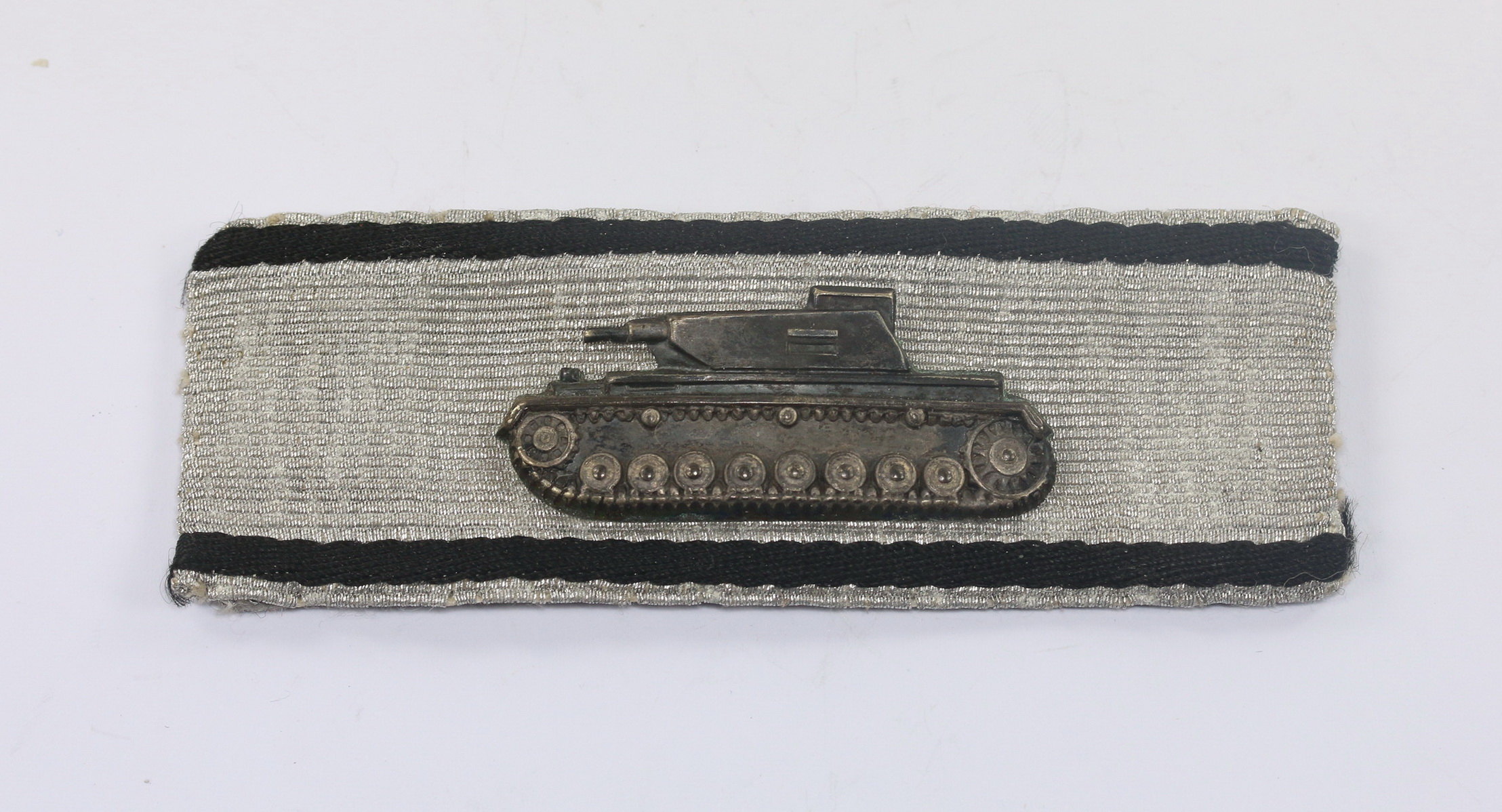
Special Badge for the Single Handed Destruction of a Tank. Type Moritz Hausch Type 1 (Tank made of Tombak)
2.455,00 €
In an excellent, unworn condition. The tank made of dark oxidised tombak/brass.
Complete with all three prongs, backing plate and the typical light grey felt covering.
Not marked but a known variation that has been attributed to the company of Moritz Hausch A.G., Pforzheim (Typ 1) ,
See Dirk Schneider, Das Panzervernichtungsabzeichen sowie das Tieffliegervernichtungsabzeichen, p. 55, type 1.
Difficult to find early variant.
The special badge for the single handed destruction of a tank was an award to all ranks in the German armed forces in World War II.
It was awarded to all members of all branches of the armed forces, including members of the air force and the navy.
The tank destruction badge was created on March 9, 1942 and could be awarded retroactively from June 22, 1941.
It consisted of rectangular woven aluminum threads (32 mm x 90 mm), the top and bottom edges with thin black cotton strips woven of about 3 mm. In the middle was a tank stamped from sheet metal (usually magnetic, but also known in non-magnetic). The tank was usually dark oxidised, but silver-plated versions are also known. Interestingly, the stylised tank does not represent an enemy model, but a German Model IV tank. The tank was attached to the aluminum backing using three split pins and a counterplate. The counterplate is usually made of zinc.
On the back, the fabric is covered by gas tarpaulin or various other materials.
The badge was worn by sewing it onto the right sleeve at upper arm level. For each additional enemy tank that was destroyed or rendered incapacitated, another badge was awarded and sewn onto the sleeve. According to the announcement of March 9, 1942, the enemy armored fighting vehicle had to be destroyed in close combat or put out of action using close combat weapons or close combat means (tank rifle, rifle grenade, concentrated charge, etc.). By order of December 18, 1943, the Panzerfaust and Bazooka were also recognised as close combat weapons.
Close combat weapons were satchel charges, usually bundles of hand grenades, Molotov cocktails, anti-tank mines or hollow adhesive charges. Concentrated charges or hand grenades were thrown or placed on the tank or the track wheels and tracks to immobilise the vehicle.
To eliminate a crew, hand grenades were thrown into the tank hatches; The soldier had to climb onto the tank to do this.
Molotov cocktails, glass bottles filled with incendiary agents with a lit fuse, were thrown at the back of the tank. The burning liquid ran through the ventilation slots into the engine compartment and set it on fire, which usually led to a total failure of the vehicle. The adhesive hollow charges were equipped with magnets so that they could be attached to moving tanks..
The Golden Tank Destruction Badge was created on December 18, 1943, it differed from the single badge because of its gold-colored backing and was awarded after the 5th tank was destroyed.
The badge was exchanged for the four previously awarded, which remained in the wearers possession.
In practice, however, five silver badges were often worn instead of the one gold one. Sometimes there were no gold badges available at the front, but, on also five silver badges seemed more “impressive” than a single gold one.
The tank destruction badges were manufactured by several manufacturers, there were minor differences in the design of the badges. Since there was initially a shortage of tank destruction badges among front-line troops, provisional badges made by soldiers themselves were also awarded or worn.
Günther Viezenz (Grenadier Regiment 7) received the most tank destruction badges with a total of 21 badges, Friedrich Anding (Clausewitz Division) with 18 badges and Willi Frey with 12 badges. Walter Kuhn (Panzerjäger Division 1) received four tank destruction badges for destroying four tanks within a single day.
Those who wore the badge were known as tank breakers and were held in high regard by the German public.
According to General Heinz Guderian, around 10,000 tank destruction badges had been awarded by May 1944. By the end of the war there were around 14,000 badges. Since there was no swastika or other forbidden symbols on the tank destruction badges, they were allowed to continue to be worn after 1945 and were also held in high regard in the Bundeswehr.
Verkauft
Sie besitzen ein ähnliches Exponat?
Sie besitzen ein gleiches, oder ähnliches Exponat und denken über einen Verkauf nach, oder möchten eine kostenlose Bewertung? Füllen Sie das folgende Formular aus und wir unterbreiten Ihnen ein Angebot.
Sie können uns auch direkt über WhatsApp kontaktieren.
Telefonisch sind wir ebenso für Sie erreichbar.
Nie wieder Neuheiten verpassen
Abonnieren Sie unseren Newsletter und wir informieren Sie jeden Freitag frühzeitig über alle Neuheiten.