
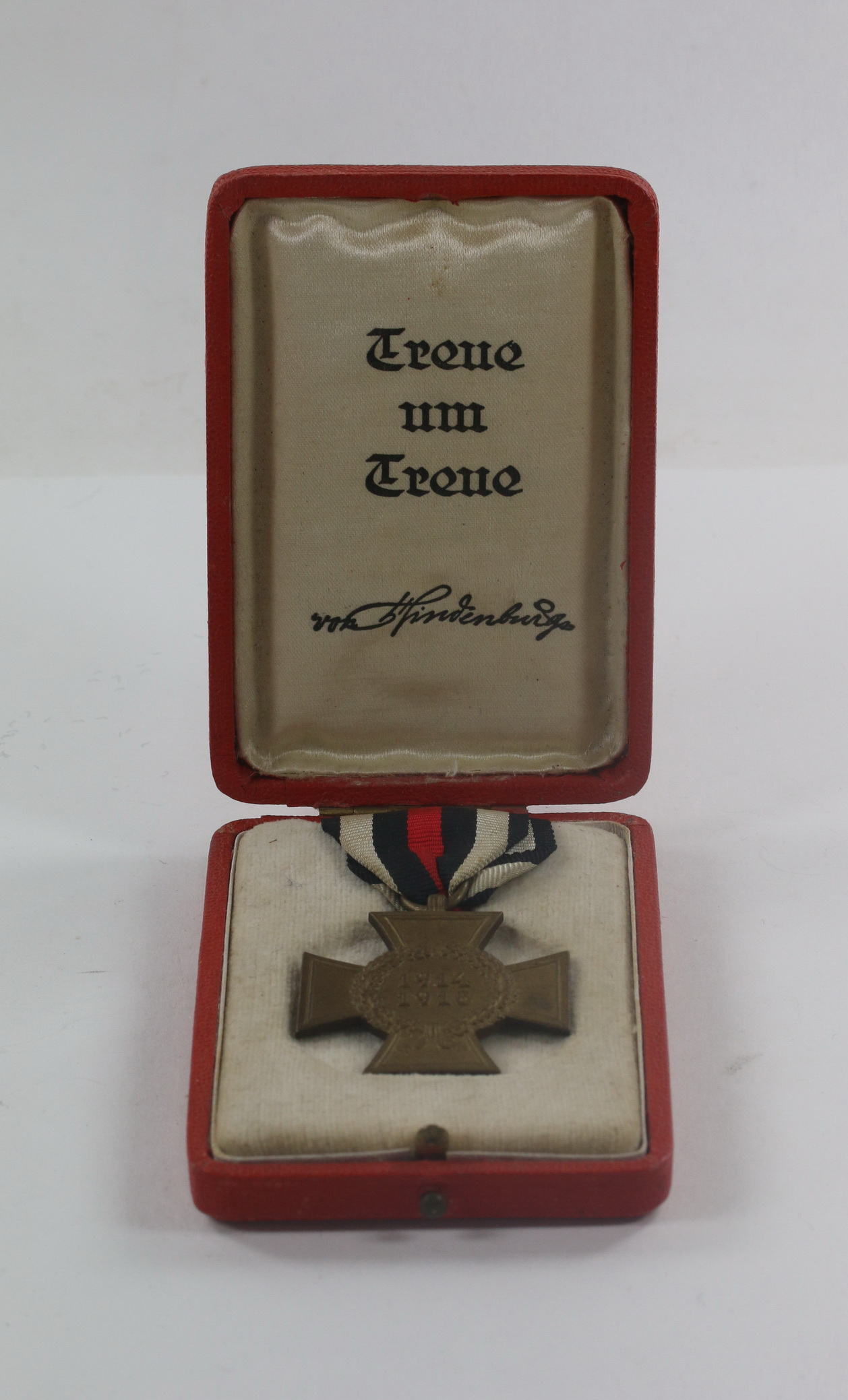
Cased Hindenburg Cross for Participants. Maker Ad. B.&L. , im Etui Treue um Treue von Hindenburg
245,00 €
Iron based and in an excellent, unworn condition with all of the bronze wash still present.
Marked on reverse with „Ad. B.&L.“.
The fitting red case in a very good, slightly used condition. Printed on the white material inside of the lid with the motto „Treue um Treue“ and a facsimile signature „von Hindenburg“.
Nice set.
The Cross of Honor of the World War (also known as the Hindenburg Cross, or Cross of Honor for frontline fighters or war participants) was established on July 13, 1934 by Reich President Paul von Hindenburg on the 20th anniversary of the beginning of the war in 1914.
Although it was established by Reich President von Hindenburg, it is still considered the first award of the 3rd Reich due to the date of its foundation.
After Hindenburgs death on August 2, 1934, the Cross of Honor was officially awarded „in the name of the Führer and Reich Chancellor“, i.e. Adolf Hitler. The opening words of the regulations were:
“In memory of the enduring achievements of the German people in the World War 1914/1918, I establish a cross of honor for all participants in the war as well as for the widows and parents of those who died as a result of being wounded or who died in captivity or went missing.”
The Cross of Honor was awarded in three versions:
– Cross of Honor of the World War for frontline fighters, usually only Cross of Honor for frontline fighters (version with crossed swords)
– Cross of Honor of the World War participants, mostly only Cross of Honor for participants in the war (without swords)
– Cross of Honor of the World War relatives, usually just a cross of honor for the relatives (without swords, blackened)
The World War (World War I) within the meaning of the Foundation Ordinance covered the period from August 1, 1914 to December 31, 1918. Any German who had performed military service on the German side or on the side of the German allies was considered a participant in the war.
Any Imperial German participant in the war who had taken part in a battle, skirmish, trench warfare or siege with the fighting troops was considered a frontline fighter.
In naval warfare, this requirement was considered to be met if a ship took part in a combat operation under a war flag.
Widows and parents of those who died as a result of wounds or those who died in captivity or went missing were considered eligible.
All external or internal injuries caused by the direct or indirect effects of combat weapons were considered wounds within the meaning of the regulations.
The status of widow was considered fulfilled if the marriage was not concluded after December 31, 1918. Furthermore, a later remarriage did not affect widow status.
Parents within the meaning of this regulation also included stepparents and adoptive parents.
Every Reich German performed military service within the meaning of the regulation if he was drafted into the German Army, the Imperial Navy or the Air Force during the First World War. As well as the staff of the Volunteer Nursing Corps, the Imperial Volunteer Automobile Corps and the Volunteer Motorboat Corps, as long as they were in the war zone.
The Cross of Honor was only awarded upon application (using a sample application form). In the case of parents, if the father had already died, the mother was entitled to apply. The applications had to be submitted by March 31, 1935. In justified exceptional cases, applications were also possible after the deadline had expired. The applications usually had to be submitted to the responsible local police authority. The applications were accompanied by corresponding evidence, for example military pass, award certificates, etc. must be enclosed.
The award was usually made by the police director or mayor (independent cities), or the district administrator. If no or insufficient evidence was enclosed with the application and further findings proved necessary, the awarding authority asked the responsible Central Evidence Office for War Losses and War Graves (ZAK) in Berlin-Spandau to clarify whether the applicant was a front-line fighter or a participant in the war.
The Bavarian awarding authorities had to address such clarification cases to the branch in Munich, the Saxony awarding authorities to the branch in Dresden and the Württemberg and Baden awarding authorities to the Reich Archives in Stuttgart.
However, this number of a total of 8,041,414 crosses is to be regarded as inaccurate, since the Reich Minister of the Interior Wilhelm Frick changed the regulations on November 30, 1938 so that the Cross of Honor could now also be awarded to people who lived in the “Ostmark” (Austria). ) and lived in Sudeten German areas.
According to a further decree dated June 30, 1942, the Cross of Honor could also be awarded to ethnic German participants in the World War who lived in the “recovered” areas in the west and east (e.g. in Alsace-Lorraine, etc.).
Cautious estimates therefore assume that the total number of all Crosses of Honor up to 1945 was around 10,000,000.
According to the law on titles, medals and decorations of July 26, 1957, holders are permitted to wear this award in the Federal Republic of Germany. The law does not contain any explicit mention of the Cross of Honor and does not prescribe a modified form, since the cross was already awarded without National Socialist symbols when it was founded.
Verkauft
Sie besitzen ein ähnliches Exponat?
Sie besitzen ein gleiches, oder ähnliches Exponat und denken über einen Verkauf nach, oder möchten eine kostenlose Bewertung? Füllen Sie das folgende Formular aus und wir unterbreiten Ihnen ein Angebot.
Sie können uns auch direkt über WhatsApp kontaktieren.
Telefonisch sind wir ebenso für Sie erreichbar.
Nie wieder Neuheiten verpassen
Abonnieren Sie unseren Newsletter und wir informieren Sie jeden Freitag frühzeitig über alle Neuheiten.