
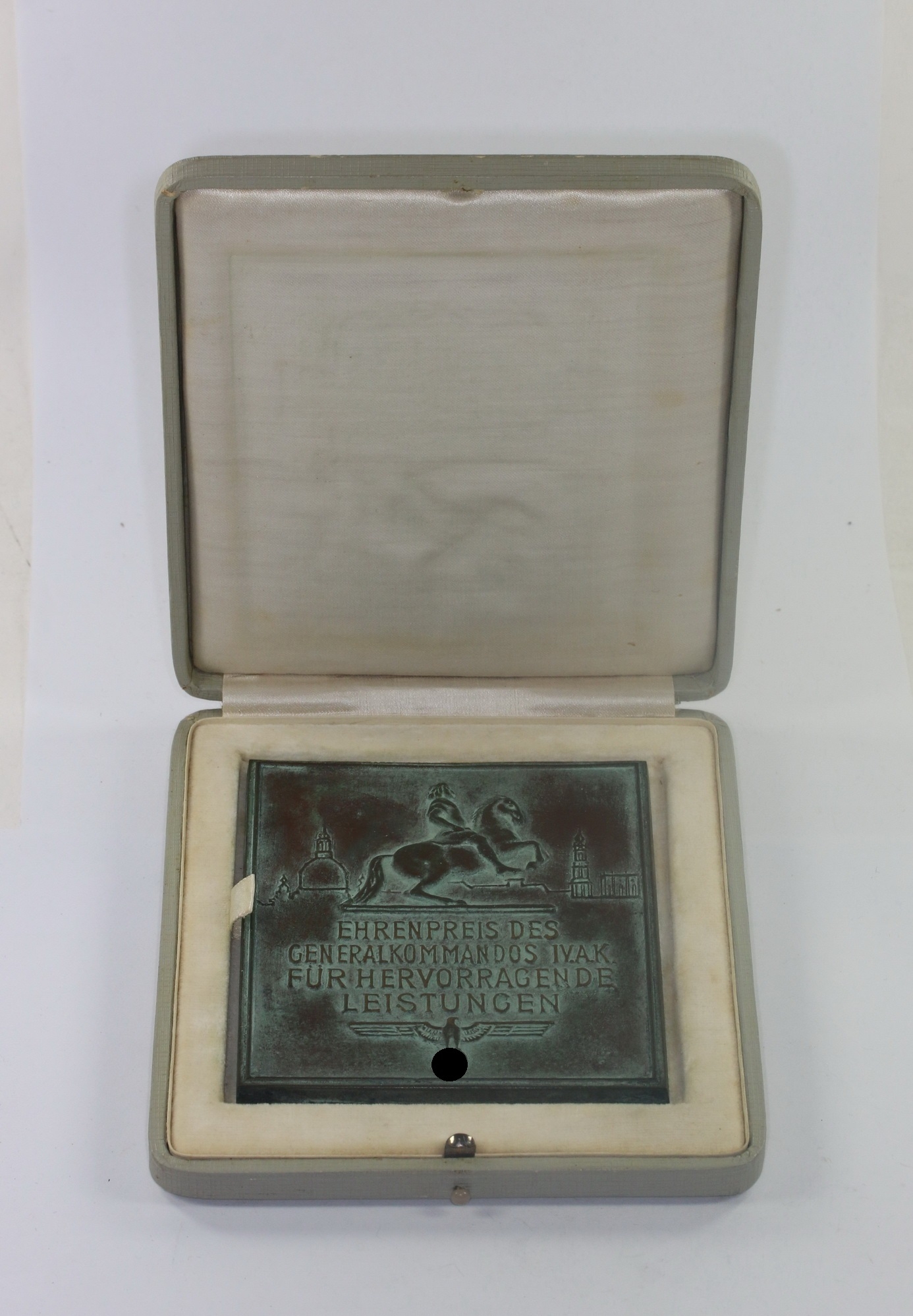
Cased Plaque – Ehrenpreis des Generalkommandos IV. A.K. für Hervorragende Leistungen.
995,00 €
Honour Prize for Special Achievement General Command IV.
Cast bronze and in a very good, slightly used condition.
Silhouette of Dresden with gold horsemann. Below the text „Ehrenpreis des Generalkommandos IV. A.K. für Hervorragende Leistungen“. With Army type eagle with swastika. Size approx.110 x 90 mm.
The fitting case in a very good, slightly used condition.
Extremely difficult to find.
History
The IV. Army Corps of the Wehrmacht was. Deployed on the Eastern Front from 1941 onwards, the General Command was temporarily referred to as the Schwedler group after its commander. After the destruction in the Stalingrad pocket from December 1942 as Gkdo. z. b. V. Mieth reorganized and on July 20, 1943 again designated as General Command IV Army Corps. Also known as the Mieth group between May / July 1944.
1939/1940
In September 1939, the largest part took part in the attack on Poland with the subordinate 4th and 46th Infantry Divisions. From May 10, 1940, the corps participated in the Fall Gelb as part of the 6th Army in the western campaign. The 7th, 18th and 35th Infantry Divisions were subordinate to this. On May 11th the Albert Canal was crossed, the Demer section crossed at Tienen and from May 13th the Dyle position was attacked and breached on May 16th. With the 7th, 31st and 35th Infantry Divisions, the Corps tried in vain on May 20th and 21st to break through the English positions on the Scheldt on both sides of Tournai. For three days the IV. Corps remained trapped on the eastern part of Lille, while on May 22nd it was on the right flank of the XI. Army Corps succeeded in forming a bridgehead on the north bank of the Scheldt southwest of Oudenarde. After regrouping, the IV. Corps was drawn on the south bank of the Lys to Bossuyt and deployed against the enemy positions at Tourcoing. On the left flank the 31st Infantry Division it stood in the space between Halluin and Menin, while other parts advanced on either side of the Courtrai and crossed the Lys. While the 14th and 18th Infantry Divisions bypassed Courtrai in the north, the 31st Division reached the breakthrough to the west at Menin. In the continuation of the attack on the Yser Canal, between the IV. And XI. Army Corps, the Xth Army Corps, into whose area the 14th Division passed, pushed in. The General Command waived the possible advance to Kemmelberg in order to support the breakthrough of the Belgian front via Roulers to the coast with the right wing. On May 28, the Belgians surrendered, the previous tough resistance of the British gave way completely from May 29, due to the retreat on Dunkirk. In the Fall Rot, the corps acted with the 19th and 30th Infantry Divisions as a reserve for Army Group B in the second advance it was pulled forward during the first fighting. After the fighting was over, the corps remained in France as an occupying force as part of the 12th Army until May 1941. At the end of December 1940, the 24th, 58th and 208th Infantry Divisions were subordinate to the corps. In October 1934 the General Command of the IV Army Corps was formed from the 4th Division in Wehrkreis IV in Dresden. At the beginning of the Second World War, the IV Army Corps was part of the 10th Army.
1941
The IV Army Corps was on the Eastern Front from June 1941 to October 1944. At the beginning of Operation Barbarossa it was under the Army Group South of the 17th Army and operated via Rawa Ruska on Lemberg. On June 27th, the 24th, 295th and 262nd infantry divisions were subordinate to the corps in the front and the 71st and 97th light divisions in the second meeting. Advancing north of Tarnopol on Proskurow, the Schwedler group stood in the Belaya Tserkov area at the end of July. Together with the XXXXIV. Army Corps took over the cover of the southern bank of the Dnieper between Kanev and Cherkassy during the Battle of Kiev. At the end of 1941 the corps was in the area east of Artemovsk opposite the Soviet 12th Army in trench warfare, subordinate to the 9th, 76th and 94th Infantry Divisions during this time.
1942
During the Fall Blau summer offensive, the corps advanced as part of the Ruoff Army Group at the end of June 1942 from the Artemovsk area south of the Donets to Voroshilovgrad. Subordinated to the 4th Panzer Army from the beginning of August, the corps followed the advance of XXXXVIII with the 94th and 371st Infantry Divisions. Panzer Corps via Kotelnikowo to the Aksai sector.] From October 1942 to January 1943 the unit fought in the Battle of Stalingrad. As the northernmost corps of the 4th Panzer Army, it got into the Stalingrad pocket itself and was therefore also subordinated to the 6th Army on November 22nd. At the end of December, he was subordinate to the 371st and 297th Infantry Divisions as well as the Romanian 20th Infantry Division. Together with the other units of the enclosed 6th Army, the IV Army Corps was almost completely destroyed, and remnants fell into Soviet captivity.
1943
At the end of January 1943, the corps was assigned to the Hollidt Army Department as General Command e.g. V. Mieth repositioned. Deployed in April 1943 on the middle Mius section, the corps were subordinate to the 3rd Mountain Division, the 304th and 335th Infantry Divisions. On July 20, 1943, the General Command Mieth was renamed General Command IV Army Corps again during the defensive battles of the Soviet Donets-Mius offensive. In the autumn of 1943 the corps was together with the XXIX. Army corps in the southern Dnieper bridgehead from Nikopol were assigned to the 3rd Mountain Division, the 101st Jäger-, remnants of the 258th and the 302nd Infantry Divisions.
1944
In the spring of 1944 the corps fought in the section of the 6th Army with Army Group South Ukraine and had to fight its way back to the Prut. In the summer of 1944, part of the 8th Army, the 376th and 79th Infantry Divisions and the Romanian 11th Division were subordinate to the association. After the major attack by the 2nd Ukrainian Front on August 20, 1944, the corps was almost completely destroyed in the battle of Jassy.
In October 1944, the IV. Panzer Corps was set up as a successor organization from the staff of the commander in Eastern Hungary and the Storm Division Rhodes, which was renamed the Panzer Corps Feldherrnhalle before the end of the year. This corps was deployed in 1945 as part of the 8th Army (General Kreysing) in Hungary and in the Gran area on the Hron section and surrendered after the Bratislava-Brno operation at the end of the war in Slovakia.
Commanders.
General der Infanterie Wilhelm List, 1. Oktober 1935 bis 4. Februar 1938
General der Infanterie Viktor von Schwedler, 4. Februar 1938 bis 1. November 1942
General der Pioniere Erwin Jaenecke, 1. November 1942 bis 17. Januar 1943
General der Artillerie Max Pfeffer, 17. bis 31. Januar 1943
General der Infanterie Friedrich Mieth, 20. Juli 1943 bis 10. Oktober 1944
Chefs des Generalstabes
Generalmajor Friedrich Olbricht, Oktober 1935 – 10. November 1938
Generalmajor Walter Model, 10. November 1938 – 24. Oktober 1939
Oberst Otto Beutler, 25. Oktober 1939 – 20. Juni 1942
Oberst Johannes Steffler, 20. Juni 1942 – Dezember 1942
Oberst Johannes Crome, Dezember 1942 – Februar 1943
Oberst Franz Jais, 10. bis 31. Oktober 1943
Oberst Diermayer, 1. November 1943 – 15. Februar 1944
Oberst Günther Siedschlag, 15. Februar – Oktober 1944
Verkauft
Sie besitzen ein ähnliches Exponat?
Sie besitzen ein gleiches, oder ähnliches Exponat und denken über einen Verkauf nach, oder möchten eine kostenlose Bewertung? Füllen Sie das folgende Formular aus und wir unterbreiten Ihnen ein Angebot.
Sie können uns auch direkt über WhatsApp kontaktieren.
Telefonisch sind wir ebenso für Sie erreichbar.
Nie wieder Neuheiten verpassen
Abonnieren Sie unseren Newsletter und wir informieren Sie jeden Freitag frühzeitig über alle Neuheiten.