
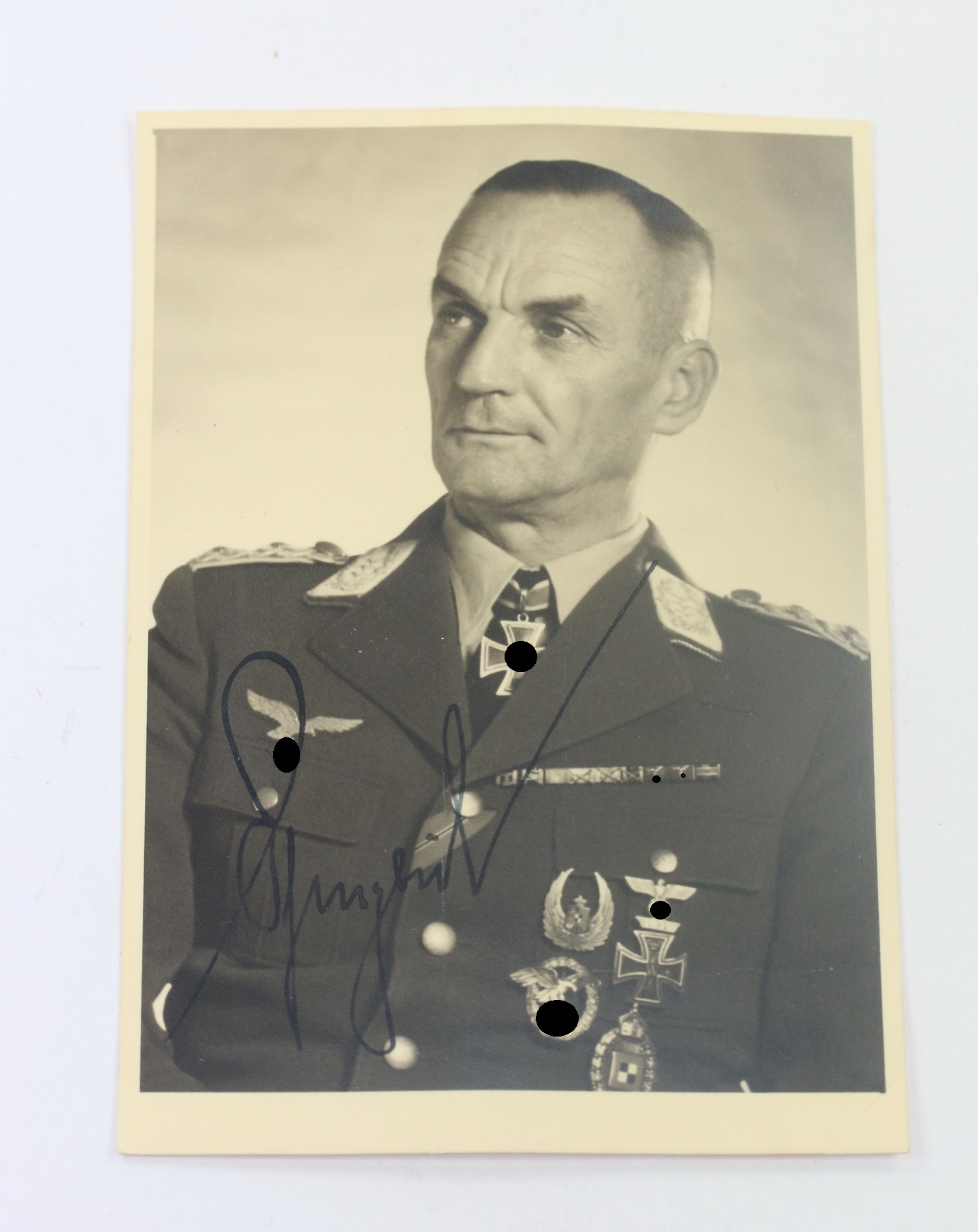
Signed Photo General der Flieger Curt Pflugbeil
90,00 €
Full uniform photo with Knights Cross and all awards the Luftwaffe General Curt Pflugbeil. Original ink signature. Size approx. 90 x 125 mm. Very uncommon.
Curt Pflugbeil (* 9. May 1890 in Hütten; † 31. May 1955 in Weende) was a German Luftwaffe General in WW2.
Ranks:
13. August 1910 Fahnenjunker
7. November 1910 Fähnrich
23. November 1911 Leutnant
21. October 1915 Oberleutnant
1. April 1921 Hauptmann
1. October 1926 umbenannt in Rittmeister
1. November 1931 Major
1. August 1934 Oberstleutnant
1. April 1936 Oberst
1. January 1939 Generalmajor
1. September 1940 Generalleutnant
1. Februar 1942 General der Flieger
Pflugbeil joined the 10th Infantry Regiment No. 134 in Plauen on April 1, 1910, after being promoted to lieutenant, he was employed as a company officer in the 2nd Company. Pflugbeil served on the western front when the First World War broke out. As leader of the MG company in June 1915 at Givenchy-lès-la-Bassée on the Artois front, he was instrumental in repelling an attempted breakthrough by allied forces. For this, on July 21st, 1915 he was awarded the Knights Cross of the Military Order of St. Henry by the King of Saxony Friedrich August III.
At the end of 1915, Pflugbeil transferred to the air force and from December 15, 1915 to the end of January 1916, he completed his training as a pilot. He then joined the combat squadron 24 as a pilot until December 1916, later he was with squadron 4 of the Supreme Army Command (Kagohl 4). On December 19, 1916, he was appointed leader of Kampfstaffel 27. From January to June 20, 1917 he was a pilot in the Schutzstaffel 9. He was appointed the leadership of Kampfstaffel 23 in Kampfgeschwader 4.
On April 23, 1918 he was seriously injured when his plane crashed. After in hospital and subsequent home leave, Pflugbeil did not return to service until August 1, 1918, when he was assigned to Army Air Park 11. He stayed there after the end of the war until the demobilization of the flight park on January 13, 1919.
In January 1919 Pflugbeil was an officer in the Air Force Replacement Department 6, from which he left on February 11, 1919. After the Versailles Treaty and the resulting ban on military aviation in Germany, Pflugbeil was transferred back to his regular regiment and served there until it was disbandec at the end of February 1919. He then joined the Voluntary Border Regiment 1 as a machine-gun officer and was also worked in the Grenzjäger Regiment 4. On September 5, 1920, Pflugbeil was taken over by the Reichswehr as first lieutenant and came to the Reichswehr Infantry Regiment 37 as a company officer. In January 1921 he moved to the 11th (Saxon) Infantry Regiment. There, on April 1st he was promoted to captain and appointed chief of the 1st company. On October 1st 1926, he was transferred to the 11th (Prussian) Cavalry Regiment and was assigned to the staff of the 4th Division in Dresden until July 31, 1927. Subsequently, he was assigned to the training staff for the military technology course. On March 31, 1928, Pflugbeil retired from military service in order to work, disguised as a civilian, building up the secret air force in the Soviet Union, Sweden and Italy. In April 1931 he was reactivated and assigned to the staff of the 3rd Division in Berlin. From October 1931 to June 1933 he was in command of the 2nd (Prussian) Driving Department 2 in Altdamm. On June 30, 1933, Pflugbeil resigned from the army, again for reasons of subterfuge, and continued to work in the still secret air force until September 1933.
On October 1, 1933, he officially joined the newly formed Luftwaffe. Until November 1933 he worked as an officer for special use in the Reich Ministry of Aviation, and later in the inspection of schools. From December 1933 to February 1934 he served as leader of the Lechfeld school advance detachment. In March 1934 he was appointed director of the German High Altitude Flight Centre of the German aviation weather service, which was actually a camouflaged fighter pilot school. After the Luftwaffe was exposed as a military force Pflugbeil commanded the Lechfeld Fighter School from March to August 1935. In September 1935 he returned to the Reich Ministry of Aviation in Berlin, where he was appointed inspector of fighters on October 1, 1935. In this position, which he held until August 6, 1939, he was also from April to September 1937 m.d.w.d.G.b. Higher in command of the Luftwaffe training units and from July 4 to August 6, 1934, representative of the commander of the 4th Aviation Division, General of Aviators, Alfred Keller.
In the course of the general mobilization, Pflugbeil was appointed commander of the Luftgaustabes on August 7, 1939. From October 8, 1939 to June 23, 1940 he commanded the Luftgau staff 16. On June 24, 1940 he was appointed commanding general and commander of Luftgau Belgium-Northern France. Then on August 20, 1940, Pflugbeil was appointed commanding general of the IV Fliegerkorps, which he led until September 3, 1943, mainly on the Eastern Front. On September 4, 1943, Pflugbeil handed over command of the corps to General der Flieger Rudolf Meister and was appointed chief of Luftflotte 1. He held this position until April 17, 1945; thereafter he commanded the Kurland Air Force Command until the end of the war.
On May 8, 1945, Pflugbeil was taken prisoner by the Soviets and sentenced to 25 years of forced labor. In view of his poor health, as he suffered from bladder cancer, he was released early on January 4, 1954 from captivity and returned to the Federal Republic of Germany.
Verkauft
Sie besitzen ein ähnliches Exponat?
Sie besitzen ein gleiches, oder ähnliches Exponat und denken über einen Verkauf nach, oder möchten eine kostenlose Bewertung? Füllen Sie das folgende Formular aus und wir unterbreiten Ihnen ein Angebot.
Sie können uns auch direkt über WhatsApp kontaktieren.
Telefonisch sind wir ebenso für Sie erreichbar.
Nie wieder Neuheiten verpassen
Abonnieren Sie unseren Newsletter und wir informieren Sie jeden Freitag frühzeitig über alle Neuheiten.