
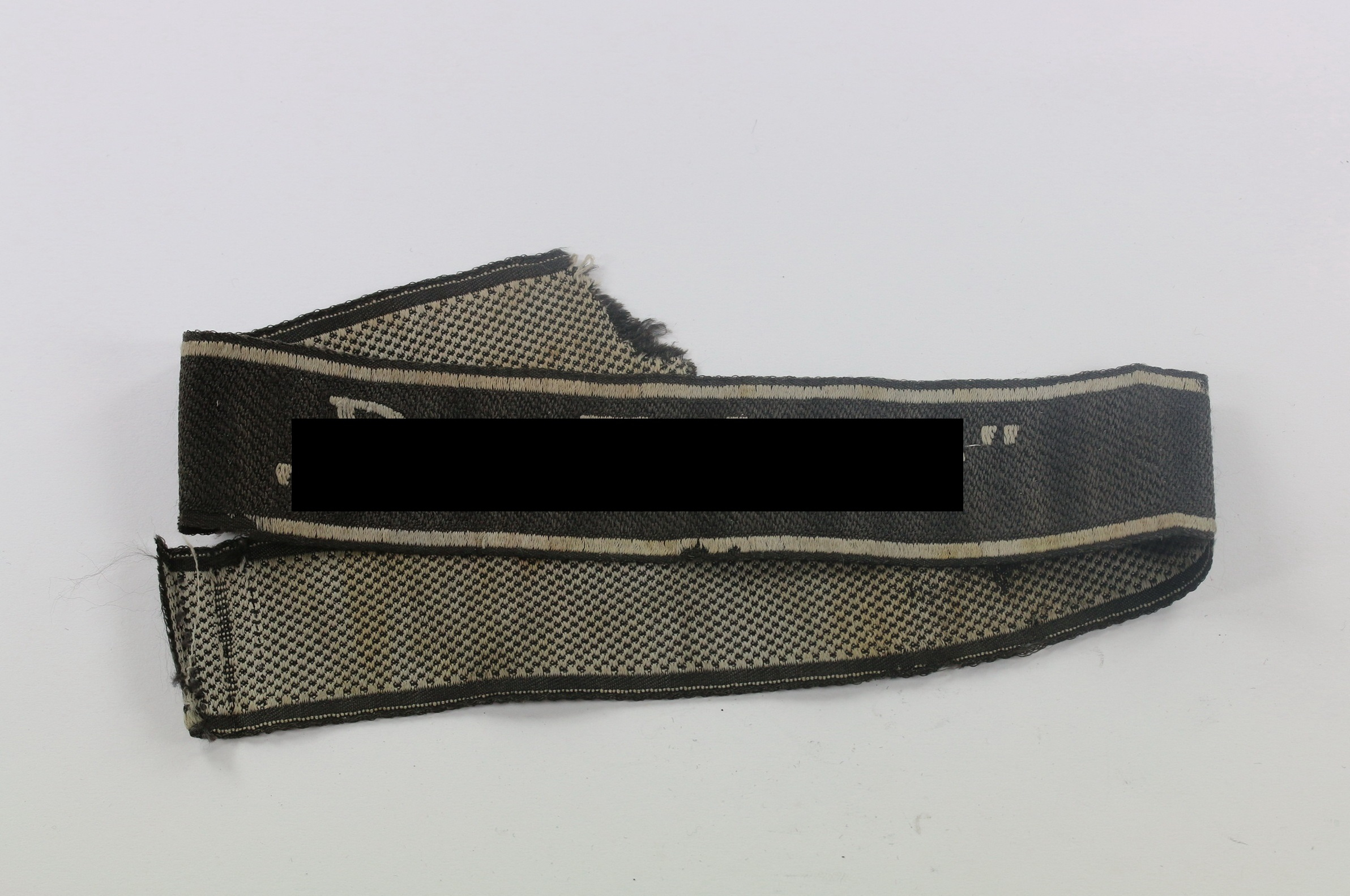
Waffen-SS, Cuffband Der Führer för Enlisted. Maker Bevo Wuppertal
1.595,00 €
Bevo weave and in a very good, slightly worn condition. Removed from the jacket. Length approx. 37 cm. With woven maker „Bevo Wuppertal“.
Very difficult to find original and in nice condition.
The SS-Standard „Der Führer“, later (from 1939) SS-Regiment „Der Führer“ and (from 1941) SS-Panzergrenadier-Regiment 4 „Der Führer“ was a military formation of the Waffen-SS and fought on almost all fronts of the 2nd World War. SS Standard/Regiment „Der Führer“ The later regiment was set up after the annexation of Austria to Das Reich in March 1938 as the 3rd SS Standard „Der Führer“ of the SS Verfordungstruppe (VT) under the command of SS Standartenfuhrer Georg Keppler. The staff and the I. Sturmbann were in Vienna, the II. Sturmbann in Graz and the III. Sturmbann in Klagenfurt. Because of this, many soldiers of the regiment came from Austria. The first action was during the invasion of Sudetenland and the rest of Czechoslovakia in 1939. During the campaign against Poland, the regiment was in Prague. It then became part of the SS-Verfugalungsdivision and was transferred to the western border in December, where it took part in the western campaign. It then remained in France as part of the occupying forces.
SS Panzergrenadier Regiment 4 „Der Führer“ was reorganised nto a Panzergrenadier Regiment (No. 4) under the SS Division „Reich“. In the war against the Soviet Union, the regiment took part in the Battle of Kyiv. The regiment was almost completely destroyed in the Battle of Rzhev in battles in the Elnja Bulge, the advance on Moscow and, above all, during the defensive battle of 1941/42. After the breakthrough of strong Soviet forces west of Moscow, which had advanced to the rear of Army Group Center in January 1942, the Commander-in-Chief of the 9th Army, General Walter Model, ordered the regiment under Obersturmbannfuhrer Otto Kumm to the Volga bend near Rzhev. It was supposed to hold a thin barrier that secured a connection with neighboring army units. Of the 2,000 men who fought off seven Soviet divisions for a month in temperatures as low as -52 degrees, only 35 survived. In the course of 1942, the regiment was formed from convalescents and recruits again into a single unit. After the lost Battle of Stalingrad, the regiment was transferred to the southern wing in 1943 and helped to stabilize it again. In the summer it took part in the Battle of the Kursk Bulge and was almost completely wiped out a second time. Another deployment in France followed, which was uncompleted when it was transferred to the invasion front in 1944. During the transfer, the massacre at Oradour-sur-Glane was committed by 120 members of the 3rd Company of the 1st Battalion. The regiment played a key role in keeping the Falaise pocket open, suffering heavy losses in the process. Up to and during the Battle of the Bulge, the regiment again suffered heavy losses. In 1945 the regiment was transferred to the Eastern Front in Hungary, where it was to take part in Operation Spring Awakening. The operation failed and the regiment retreated fighting through Austria. There it surrendered to US troops after the surrender.
Verkauft
Sie besitzen ein ähnliches Exponat?
Sie besitzen ein gleiches, oder ähnliches Exponat und denken über einen Verkauf nach, oder möchten eine kostenlose Bewertung? Füllen Sie das folgende Formular aus und wir unterbreiten Ihnen ein Angebot.
Sie können uns auch direkt über WhatsApp kontaktieren.
Telefonisch sind wir ebenso für Sie erreichbar.
Nie wieder Neuheiten verpassen
Abonnieren Sie unseren Newsletter und wir informieren Sie jeden Freitag frühzeitig über alle Neuheiten.